
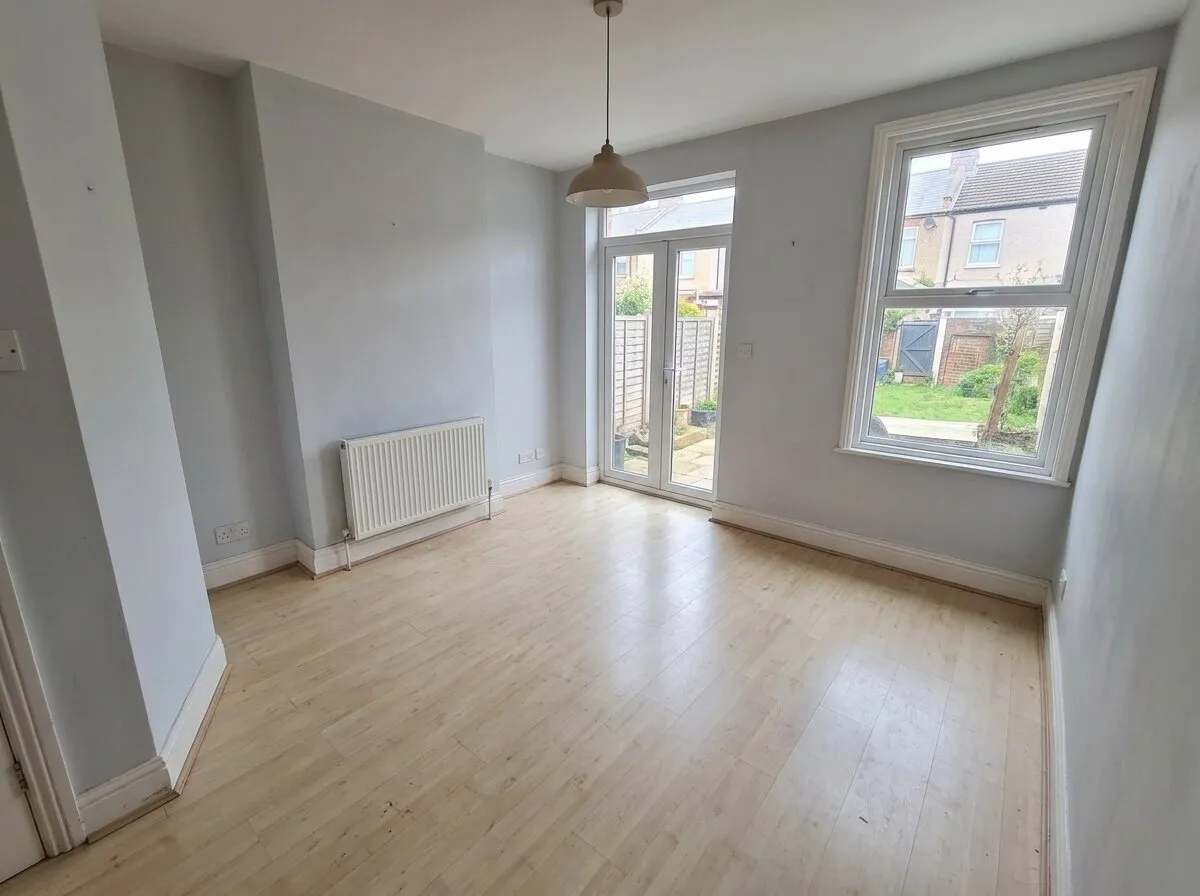
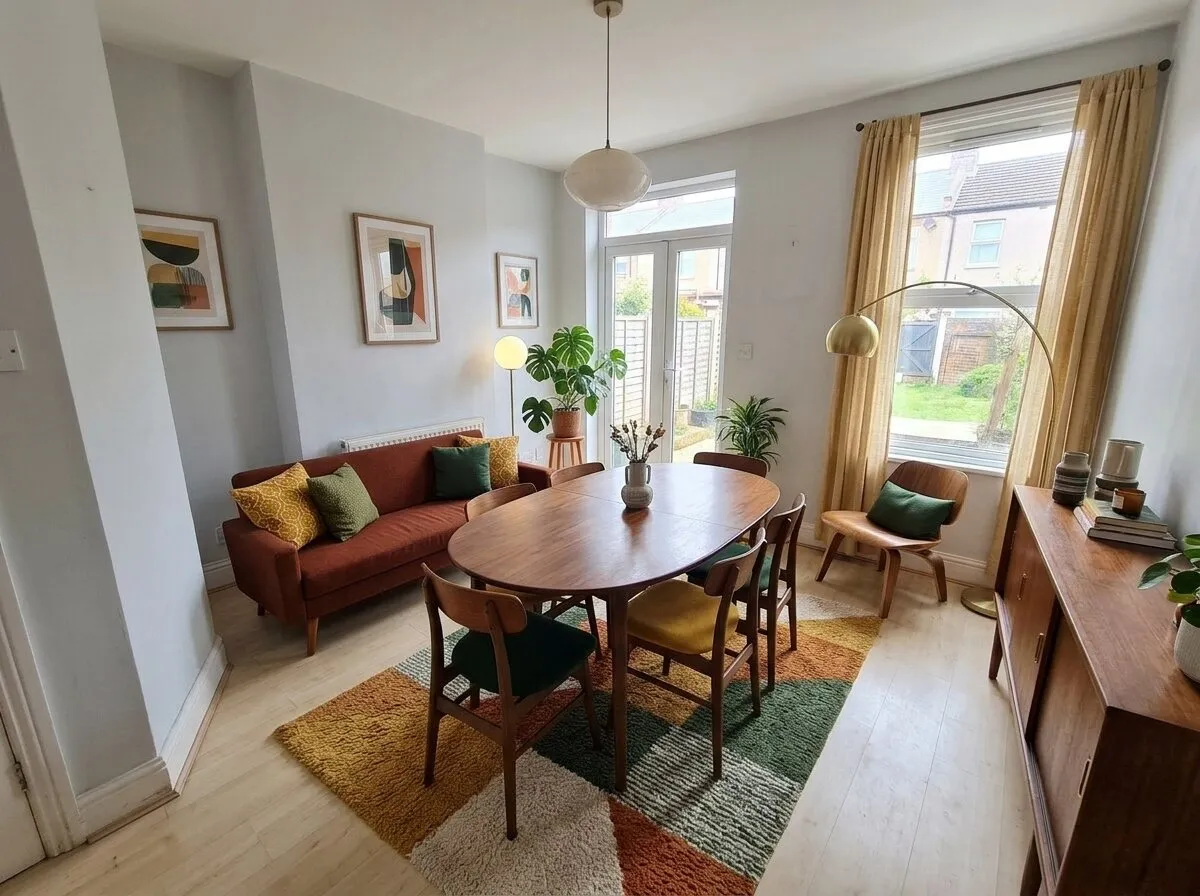
Furnish empty room, Mid-century style: a table and six chairs, a rust sofa, a sideboard, an arc lamp, curtains, prints, plants and a rug added; the walls, floor, French doors, window and radiator stayed.
Before: an AI-generated sample room. After: the result from roomvia.
The short version
- The rule. California Business and Professions Code §10140.8, added by AB 723, covers licensees and people acting on their behalf. It applies when they use a digitally altered image in an ad for the sale of real property.
- What the ad needs. A statement that the image has been altered, on or next to the image. A link, URL or QR code to the unaltered original. And words saying the originals can be seen there.
- What counts. Edits that add, remove or change things in the photo, made with AI or with ordinary photo software. Common adjustments are left out when they don’t change how the property is shown.
- The MLSs. They differ. Some want the disclosure in a text field and don’t allow text on the photo.
- Penalties. AB 723 sets none of its own. Only a willful violation of the Real Estate Law, or knowingly taking part in one, is a misdemeanor.
- 2027. On 2027-01-01, an amendment to §10140.8, a California rental rule and a Wisconsin rule take effect.
What the statute says
AB 723 (Pellerin) is Chapter 497, Statutes of 2025. It was chaptered on 2025-10-10 and added §10140.8 to the Business and Professions Code. It has applied since 2026-01-01 (AB 723).
Subdivision (a)(1) says who it covers and what the ad must include. It covers “a real estate broker or salesperson, or person acting on their behalf, who includes a digitally altered image in an advertisement or other promotional material for the sale of real property.” That ad “shall include … a statement disclosing that the image has been altered and a link to a publicly accessible internet website, URL, or QR code that includes, and clearly identifies, the original, unaltered image.”
It goes on: “The statement shall be reasonably conspicuous and located on or adjacent to the image and shall include language indicating that the unaltered images can be accessed on the linked internet website, URL, or QR code.”
Subdivision (a)(2) adds a rule for websites. When the ad is posted on a website the licensee, or someone acting for them, controls, they must “include the unaltered version of the images … in the posting”, or link to a public site that clearly identifies the originals. If they link, the statement must say the unaltered images can be accessed there.
Subdivision (b) defines the term. A digitally altered image is “an image, created by or at the direction of the real estate broker or salesperson, or person acting on their behalf, that has been altered through the use of photo editing software or artificial intelligence to add, remove, or change elements in the image, including, but not limited to, fixtures, furniture, appliances, flooring, walls, paint color, hardscape, landscape, facade, floor plans, and elements outside of, or visible from, the property, including, but not limited to, streetlights, utility poles, views through windows, and neighboring properties.”
An image is not digitally altered if “only lighting, sharpening, white balance, color correction, angle, straightening, cropping, exposure, or other common photo editing adjustments are made that do not change the representation of the real property” (§10140.8).
Who it applies to
The rule names brokers and salespersons, and any “person acting on their behalf”. That reaches the people who work for an agent, such as a photographer, a stager or a marketing assistant.
It covers every “advertisement or other promotional material”, not only the MLS. Flyers, postcards, social posts, email and websites all count. San Diego MLS’s FAQ puts it this way: AB 723 “applies to real estate advertising, including MLS listings and other marketing materials” (SDMLS FAQ).
The statute has no exemption for a medium, an MLS or a small business.
What counts, and what doesn’t
It isn’t only about AI. The definition names “photo editing software or artificial intelligence”. An edit made by hand in ordinary photo software counts too.
Taking things out counts. “Remove” is in the definition. An emptied room, a decluttered room or a photo with an object erased falls under it. Arizona’s ARMLS says the same about decluttering: a decluttered room needs its Digitally Altered label (ARMLS).
The view counts. Changes to things outside the property, or visible from it, are named: streetlights, utility poles, views through windows and neighboring properties.
Common edits are left out, with a limit. Lighting, sharpening, white balance, color correction, angle, straightening, cropping and exposure are left out only when they “do not change the representation of the real property”. An edit from that list still counts when it changes how the property is shown.
Some cases are open. The statute doesn’t settle edge cases such as a new sky or a day-to-dusk edit. It says nothing about renderings of homes that aren’t built yet. Ask your broker or your MLS about these.
Each pair below was made with roomvia. Each one adds, removes or changes elements of the room, so in California, an agent who used the after photo in an ad for a sale would need to disclose it.
Digitally altered rooms made with roomvia
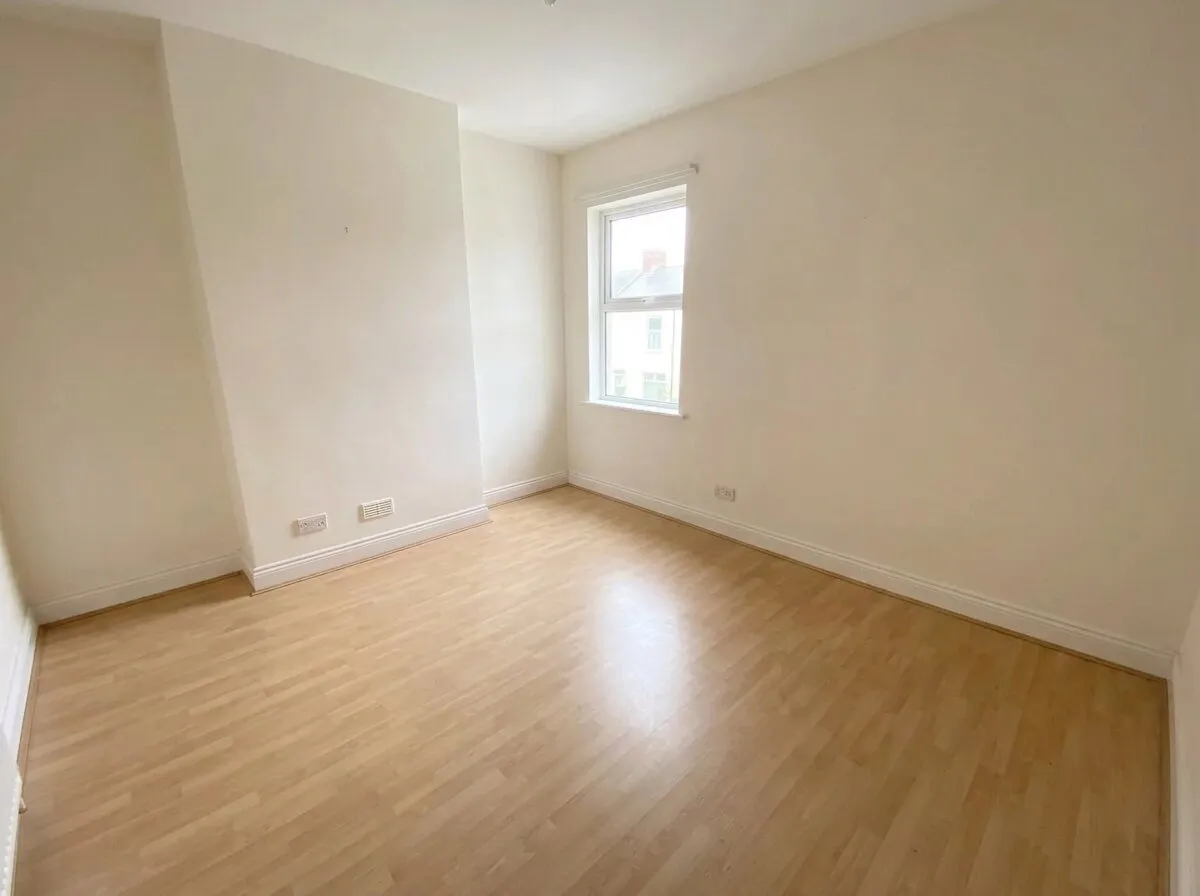
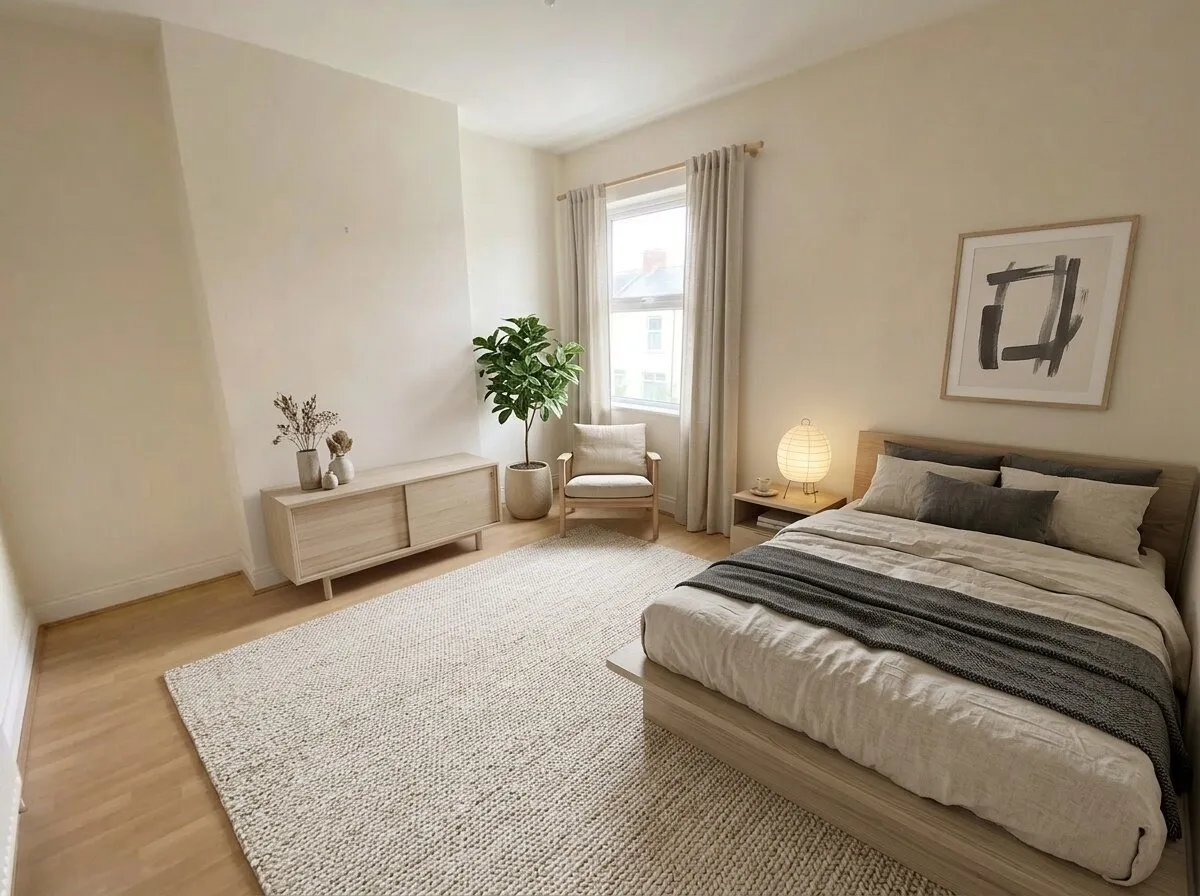
Furnish empty room, Japandi style: a platform bed, rug, armchair, sideboard, bedside table and lamp, curtains, a plant and art added; the walls, floor, window and chimney breast stayed.
Before: an AI-generated sample room. After: the result from roomvia.
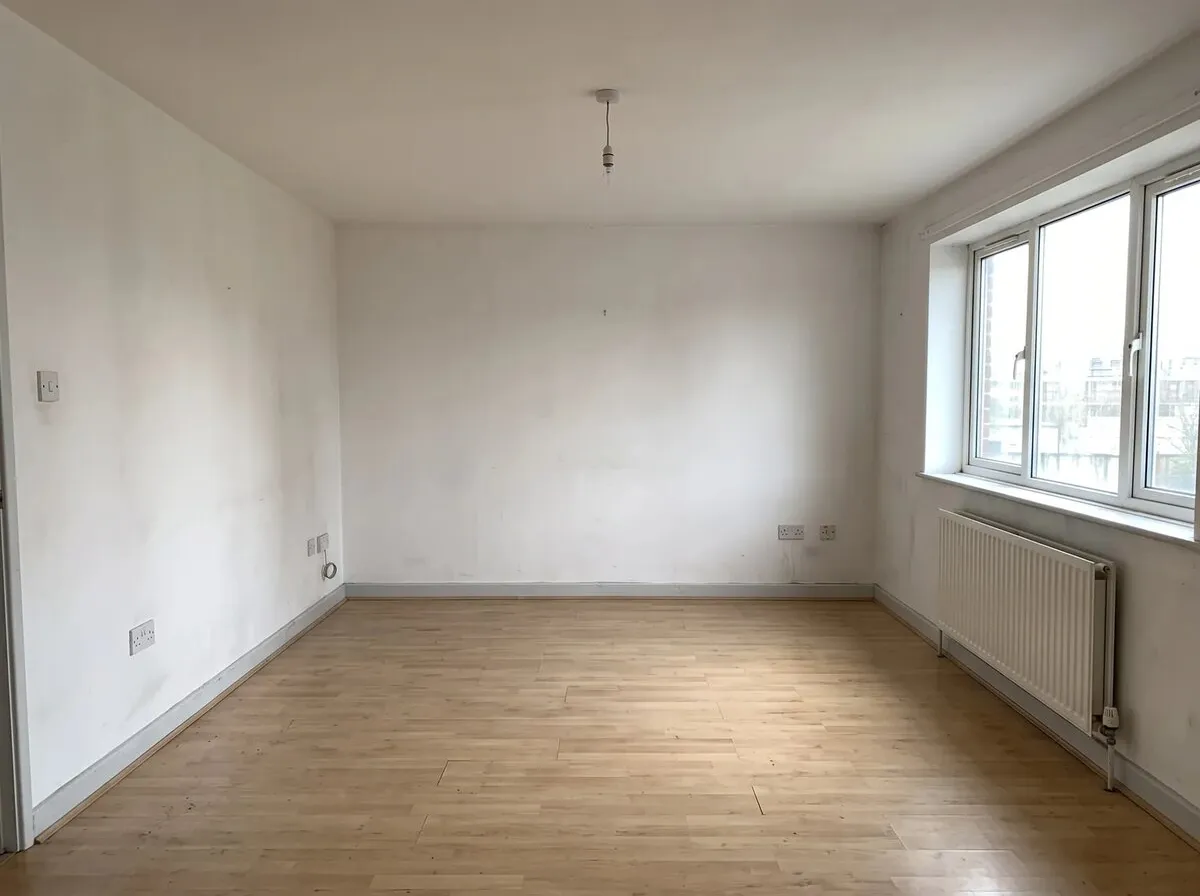
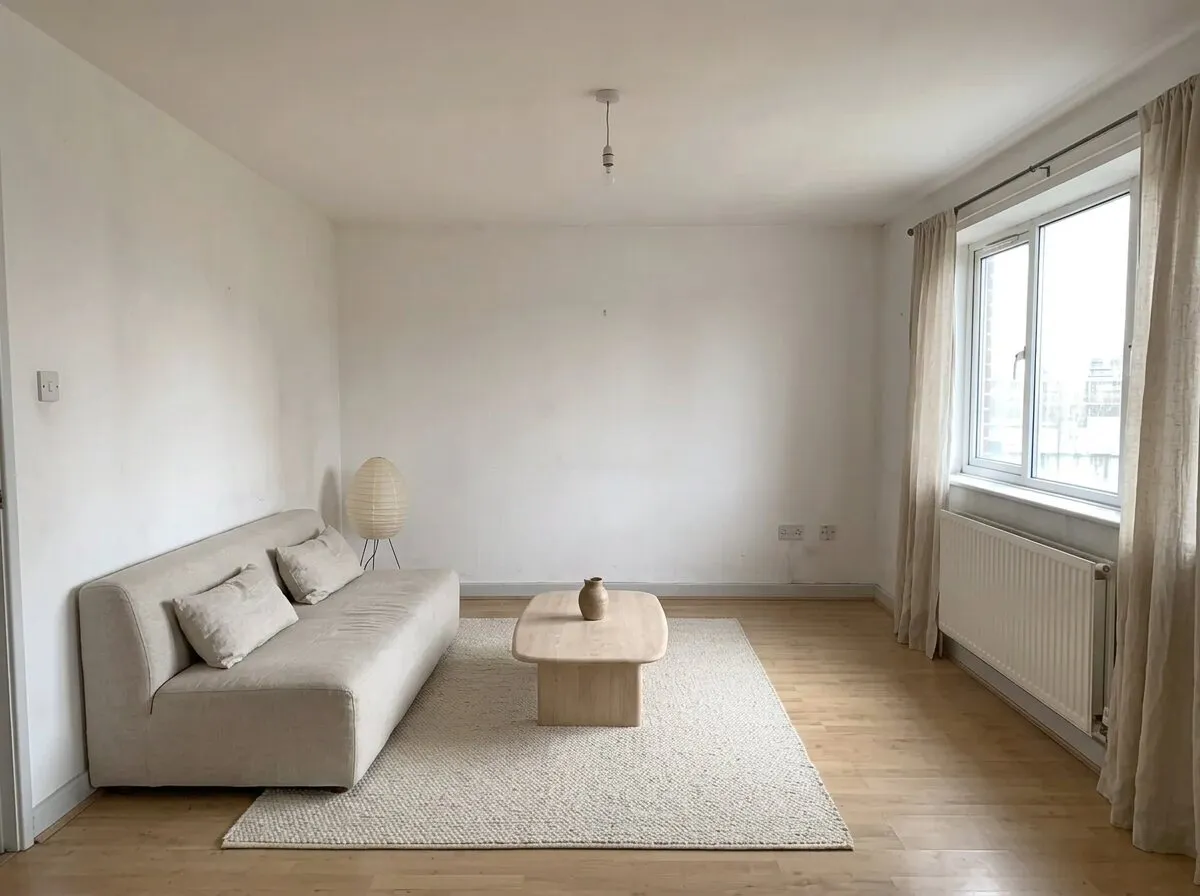
Furnish empty room, Minimalist style: a sofa, a coffee table, a rug, a floor lamp and curtains added; the white walls, window, radiator, floor and ceiling light stayed.
Before: an AI-generated sample room from the app. After: the result from roomvia.
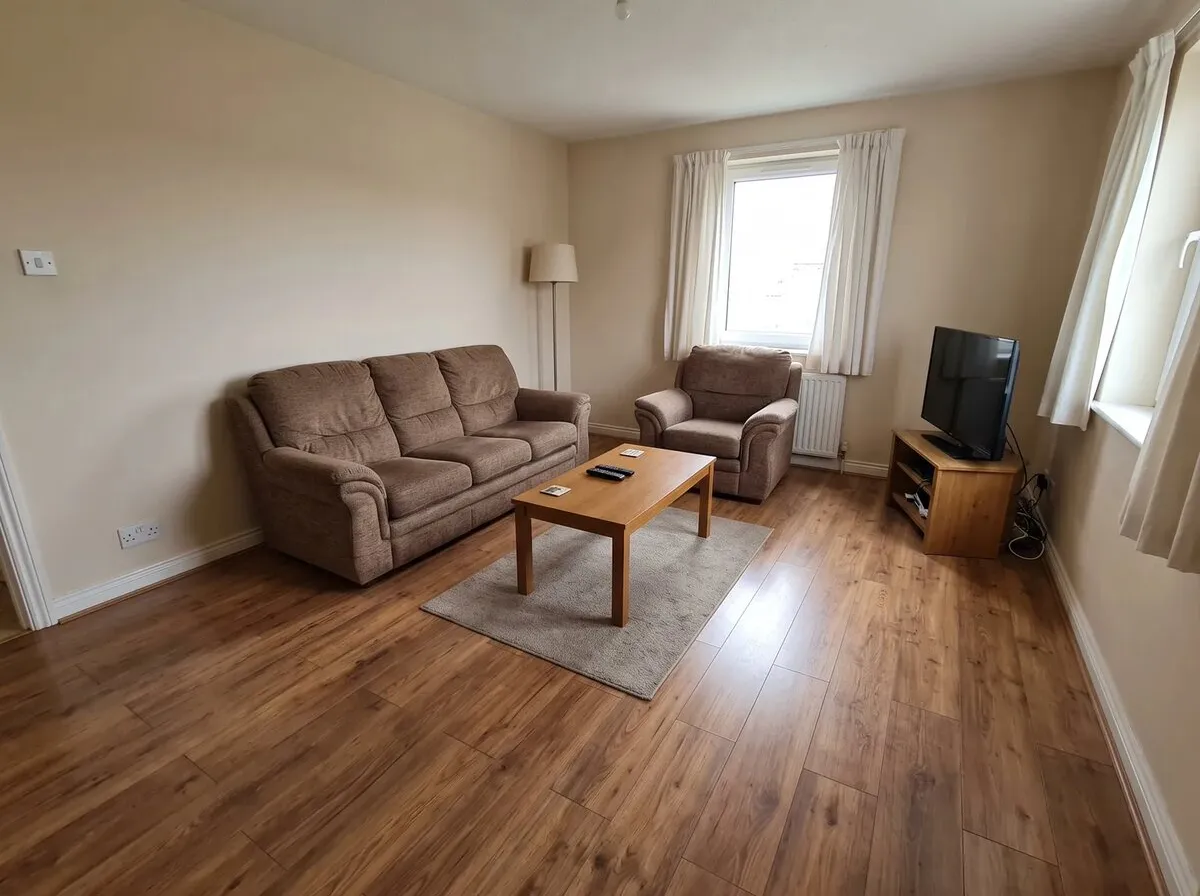
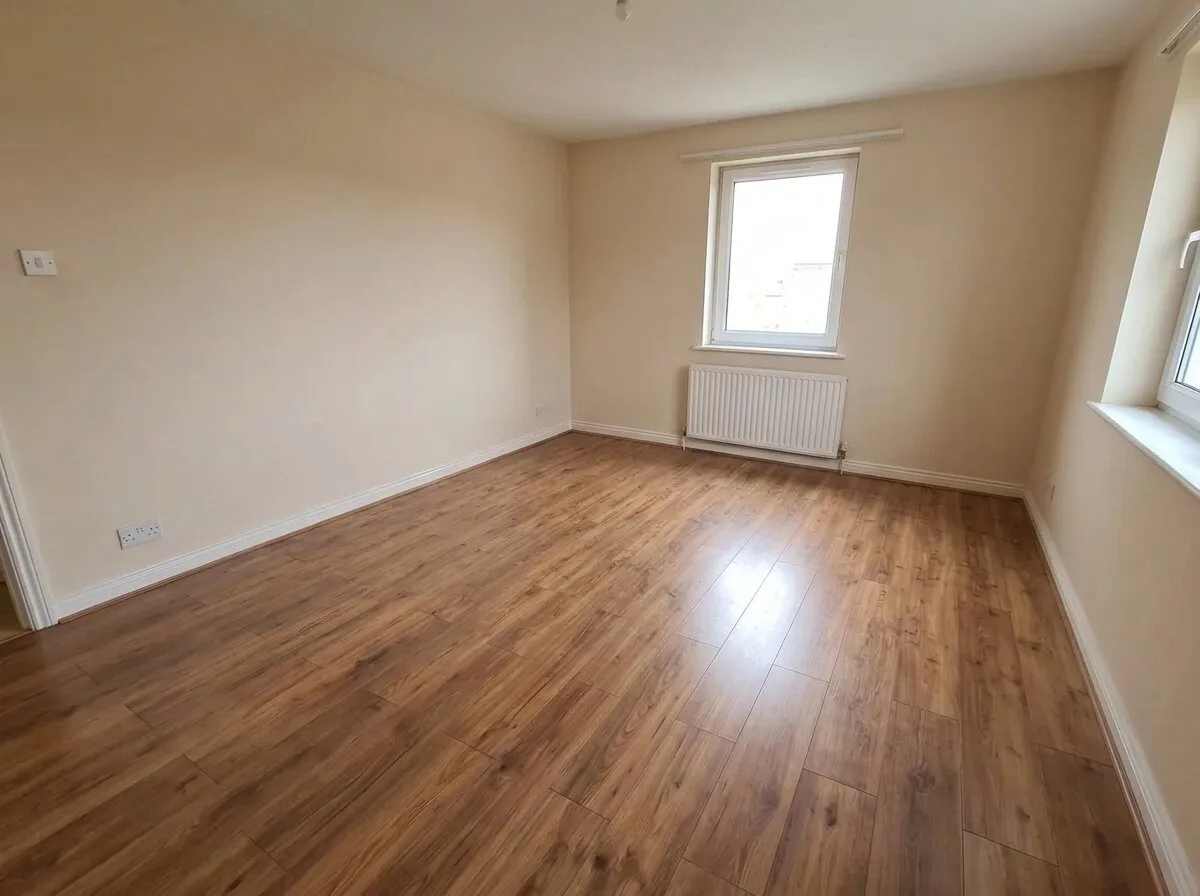
Remove furniture: the sofa, armchair, TV and stand, table, rug, lamp and curtains went; the windows, radiator, switch and sockets stayed.
Before: an AI-generated sample room from the app. After: the result from roomvia.
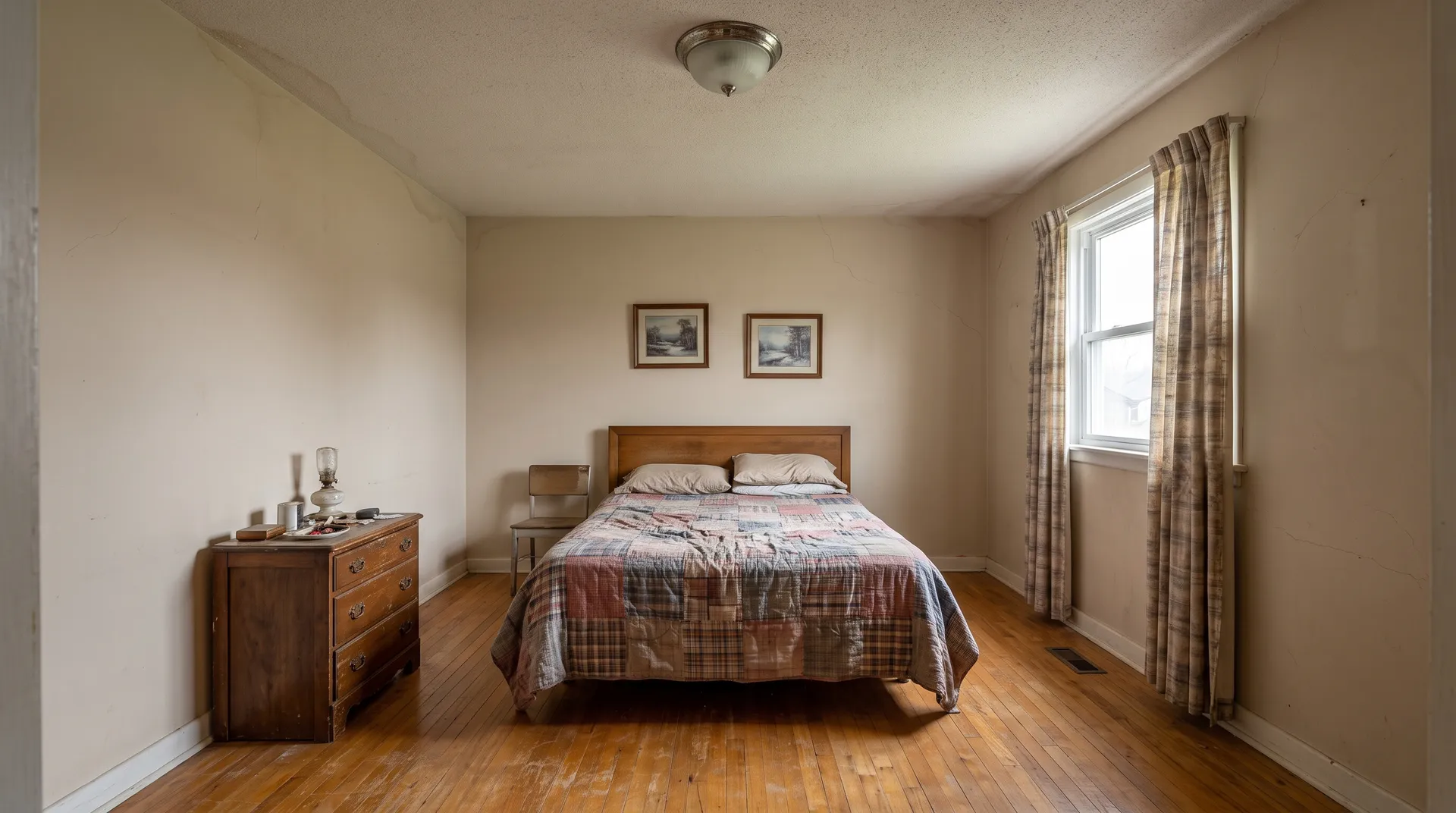
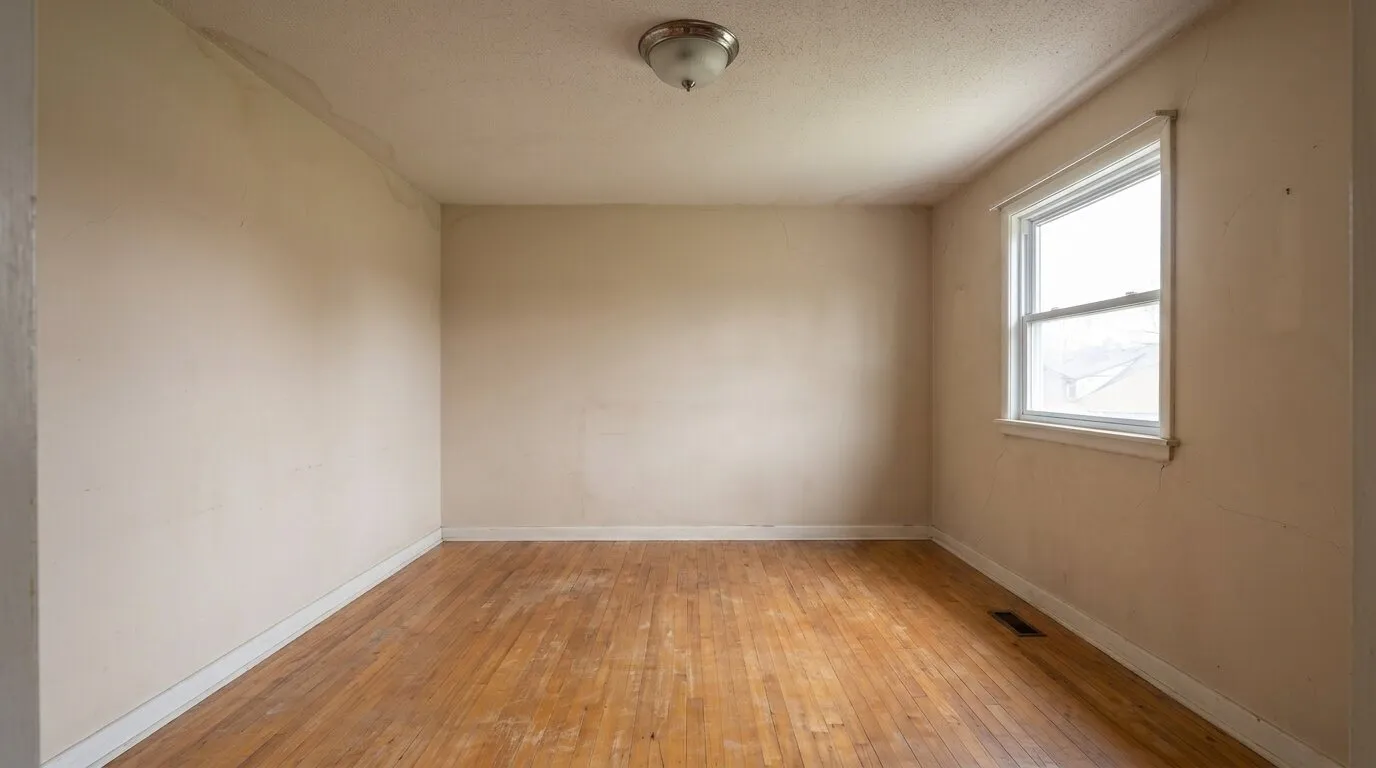
Remove furniture: the bed, chest of drawers, chair, pictures and curtains went; the window, floor vent, ceiling light and wall cracks stayed.
Before: an AI-generated sample room. After: the result from roomvia.
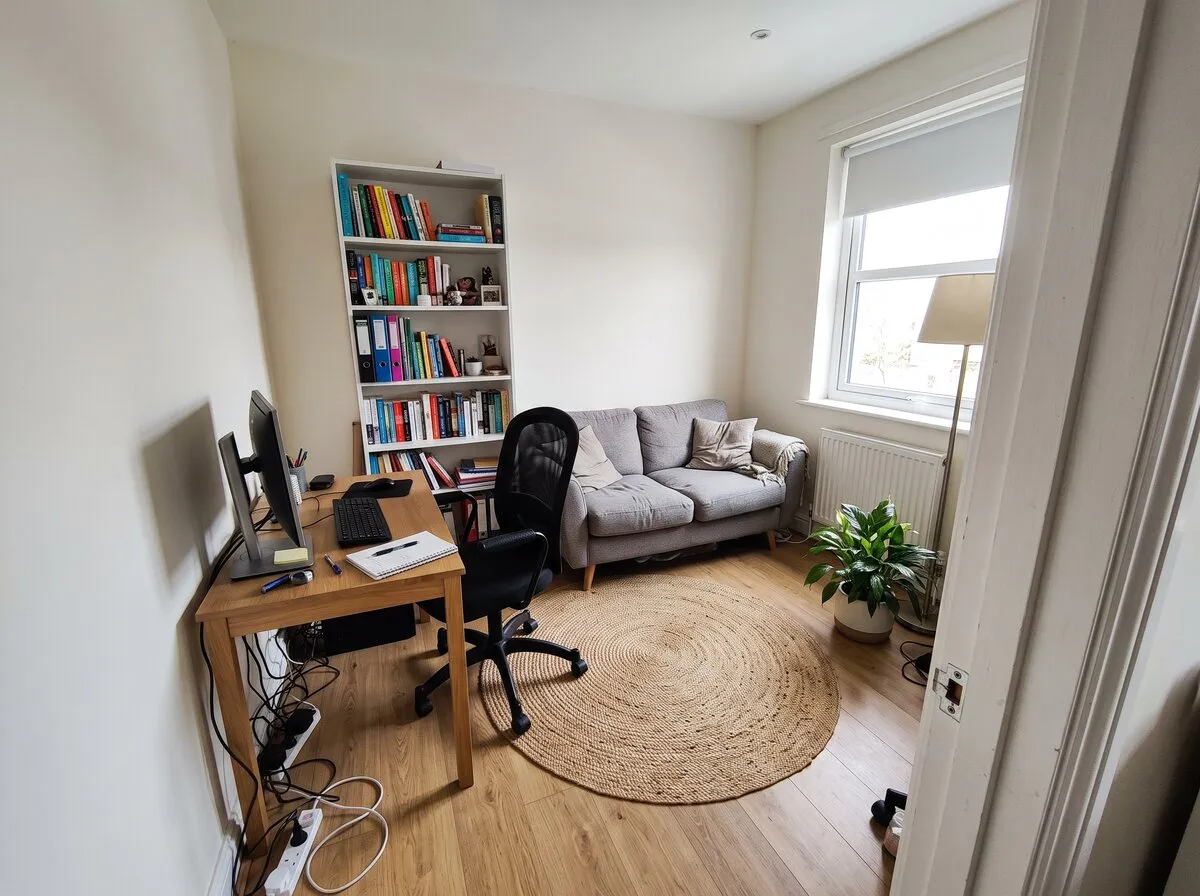
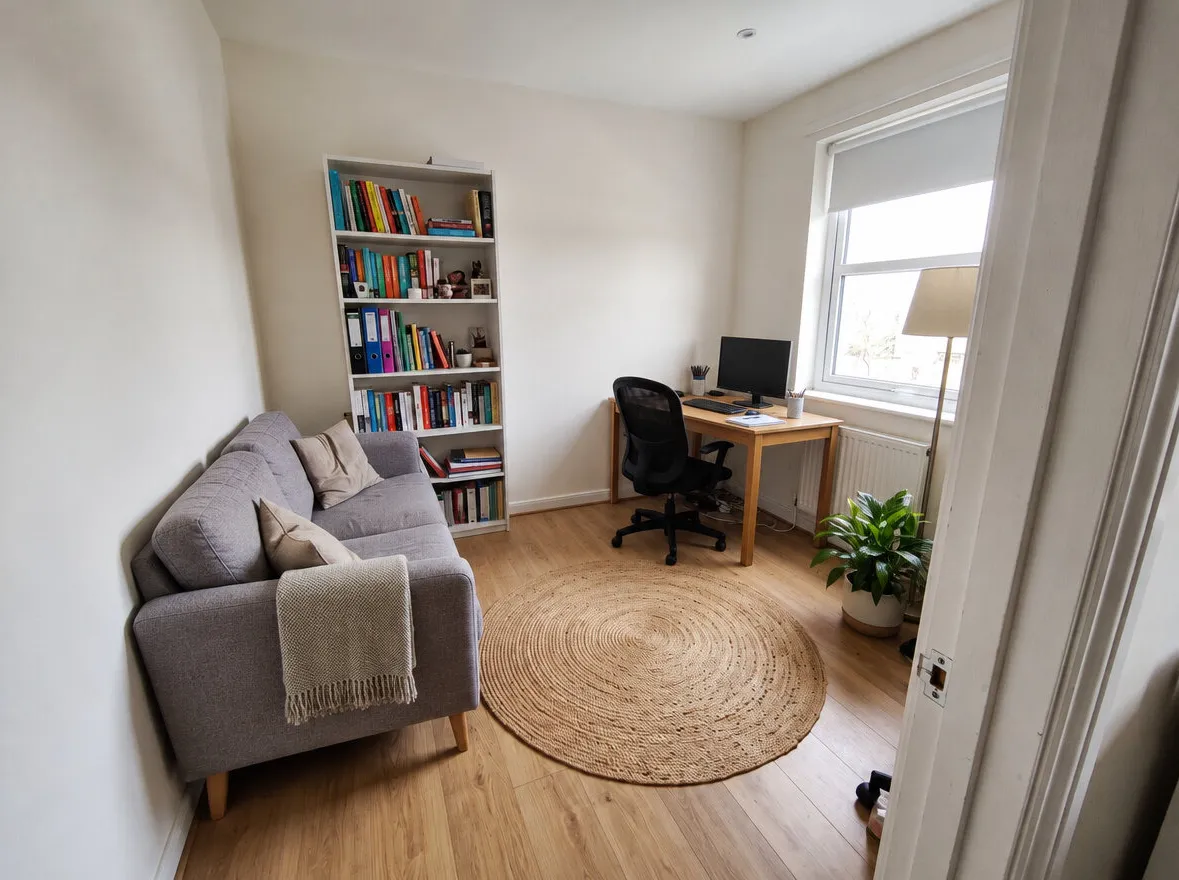
Rearrange furniture, no wish: the sofa moved to the left wall, the desk and chair to the back corner by the window; the bookcase, lamp, plant and rug stayed.
Before: an AI-generated sample room. After: the result from roomvia.
What the statement must do
Read together, (a)(1) asks for five things:
- Say that the image has been altered. The statute sets no exact words.
- Be “reasonably conspicuous”. The statute doesn’t define this, and it sets no size, font or contrast.
- Sit “on or adjacent to the image”. A stamp on the photo is one way. A caption or a field next to the photo is the other.
- Come with a link, URL or QR code to a publicly accessible website that includes, and clearly identifies, the original.
- Say that the unaltered images can be accessed there.
So “Virtually staged” on its own covers only the first part. A stamp that reads “Virtually staged” with a second line, “See the unaltered photo at yoursite.com/12-oak”, or “Scan for the unaltered photo” next to a QR code, carries both the statement and the access language the text describes.
The link must lead to a public page. Options include your MLS’s public photo URL, your own website or your brokerage’s listing page. San Diego MLS, for example, asks you to upload the original and paste the public URL it gives that photo into the altered photo’s description field.
Some questions are still open. Does a post caption count as “adjacent” to each image in a carousel? Is a link in a profile “in” the ad? Does a side-by-side post that shows the original replace the link? The text doesn’t say. Its literal words ask for the link in every ad.
The Department of Real Estate may add detail. Legislative analyses of AB 2025 in May and June 2026 said the DRE was “currently engaged in a substantially similar rulemaking process” under AB 723 (Assembly Appropriations analysis). We found no proposed rule text as of 2026-11-08.
Penalties
AB 723 sets no penalty of its own. The Legislative Counsel’s Digest explains the link to the rest of the law: “A willful violation of the Real Estate Law is a crime” (AB 723).
That general rule is §10185. Anyone who “willfully violates or knowingly participates in the violation of this division shall be guilty of a misdemeanor punishable by a fine not exceeding ten thousand dollars …, or by imprisonment in the county jail not exceeding six months, or by a fine and imprisonment” (§10185). So a violation is a misdemeanor only when it is willful, or when someone knowingly takes part in it.
The license is the other risk. Under §10177(d), the Real Estate Commissioner may suspend or revoke a license for having “Willfully disregarded or violated this part”, the Real Estate Law (§10177).
In practice, the Senate committee analysis of AB 2025 expects prosecutions to be few, “as enforcement is most likely to occur through the DRE’s administrative complaint process rather than through criminal proceedings” (Senate analysis).
MLS sanctions are separate from the statute. San Diego MLS uses citations and removal. ARMLS fines start in December 2026. Stellar MLS removes the photos and issues an automatic Level I fine. CRMLS’s FAQ, updated 2026-02-13, said it had no fine yet and would revisit fines in 2026.
MLS rules we checked
MLS rules sit on top of the statute. We list four MLSs whose rules we read at the source. Many others have rules of their own.
| MLS and rule | Where the disclosure goes | Also (checked 2026-11-08) |
|---|---|---|
| CRMLS (California), Rule 11.5.2, from 2026-01-01 | In the photo’s text field: “Photo Modified”, “Virtually Staged”, “Digitally Altered”, “AI Altered” or a similar accurate term. A watermark is not required. | Submit the original and show it immediately before or after the altered photo. Changes to parts of the property, such as flooring, walls, paint, landscape or the facade, are banned unless the property will match by closing. Changes to things outside, such as power lines, views and neighbors, are banned. |
| San Diego MLS, Rules 7.4.2–7.4.4 and 12.8, from January 2026 | “Digitally Altered” in the label field. The disclosure may not be put on the photo, and altered photos may not carry text or watermarks. | Upload the original and paste its MLS public URL into the altered photo’s description field. Anyone advertising the listing must show the label and that description. |
| ARMLS (Arizona), Rule 8.23, from 2026-05-28 | ARMLS’s own “Digitally Altered” watermark, added inside Flexmls. No other text, and no watermarks except ARMLS’s own. | Upload the original directly before or after. Decluttering counts as altering. The education phase runs June to November 2026; fines of 200 dollars start in December 2026. |
| Stellar MLS (Florida), Articles 04.04 and 04.05 | “Virtually staged” in the photo description field, with the virtually staged box checked. Public remarks must start with “One or more photo(s) was virtually staged.” No words on the photo. | Staging is for interiors and unattached outdoor furniture or decor only, and not for homes before or during construction. Changes to permanent fixtures, added views and hidden defects are banned. |
Three of these four don’t allow your own text on listing photos, and CRMLS wants the term in a text field. Rules change. Check your MLS’s current rules before you upload.
Two other sources ask for honest ads but set no staging label. The National Association of REALTORS (NAR) Code of Ethics asks members to be “honest and truthful” and to “present a true picture” in their advertising, and its Standard of Practice 12-10 bars “misleading images”. We found no NAR rule that sets a staging label (NAR Code of Ethics). In New York, the Department of State said in its 2025-11-13 trend alert that it has no AI-specific rule, and pointed to the rule that ads include “an honest and accurate depiction of the property” (NY Department of State).
What changes on 2027-01-01
California: the AB 2025 amendment
AB 2025 (Pellerin) is Chapter 572, Statutes of 2026, approved on 2026-09-27. It has no urgency clause, so it takes effect on 2027-01-01 (AB 2025). It rewords (a) to “a link, URL, or QR code to a publicly accessible internet website”, with language that the unaltered images can be “accessed via the link, URL, or QR code”. It also adds a subdivision (c) that takes leaseholds of more than one year out of §10140.8.
California rentals: Civil Code §1940.11
The same bill adds Civil Code §1940.11 for rental ads. It covers any person, not only licensees, so landlords and property managers are included. It names images “fully generated through artificial intelligence”. The disclosure must be “reasonably conspicuous and located on or adjacent to the image”. The ad must include the unaltered version in the posting, or a link, URL or QR code to a public site that clearly identifies it, with “language indicating the unaltered images can be accessed via the link, URL, or QR code”. The original-image part doesn’t apply to an “image, architectural rendering, or artistic rendering that was not originally created through the use of a capture device”. The same common edits are left out. A licensee who breaks this rule has broken their licensing law.
Wisconsin: 2025 Wisconsin Act 69
Section 452.136(1m) of the Wisconsin Statutes takes effect on 2027-01-01: “A licensee shall in all advertising disclose if the advertising has been altered or modified using technology, including artificial intelligence, to add, remove, or change elements of the property that creates a false or misleading impression of the property” (Act 69, enrolled bill). It sets no wording, no placement and no original-photo rule, and it has no list of common edits. It is enforced through license discipline. Its last words, “that creates a false or misleading impression”, can be read two ways. They may limit the rule to misleading edits, or they may describe every edit that adds, removes or changes things. The text doesn’t settle it.
Pending, not law
New York bill A11635 (Rosenthal) is a bill, not a law. It was introduced on 2026-07-29 and referred to the Housing Committee (A11635 bill text). As written, it would add Real Property Law §443-b and cover brokers, sellers, owners and property managers, for sales and leases, AI-generated images included. The statement would have to be “conspicuously located on or adjacent to each altered image”. Website posts would need the unaltered version or a link. Common edits would be left out. If it passes, it would take effect 60 days after it becomes law. Check its status before you rely on it.
What a label can’t fix
- An edit the MLS bans. CRMLS bans changes to parts of the property unless it will match by closing. Stellar MLS bans changes to permanent fixtures, added views and hidden defects. A label doesn’t change that.
- A missing link in California. The label is only part of the statement.
- Text an MLS doesn’t allow. A stamp on a San Diego MLS, ARMLS or Stellar MLS photo breaks those rules.
- A broken link. A link that stops working no longer leads to the original.
A practical checklist
- Write down what you changed in each photo: added, removed or replaced.
- Keep every original at full size, with a file name that matches its altered copy.
- Put the originals on a public page: your MLS listing, your website or your brokerage’s site.
- For the MLS, follow its rules: the term in the field it names, the original where it asks for it (right before or after at CRMLS and ARMLS; its public URL in the description at San Diego MLS), and no text on the photo unless it asks for it.
- For ads, label each altered image on or next to it, with words saying where the unaltered photo is, and the link, the QR code or both.
- Test the link in a private browser window: no login, and the original is clearly marked.
- Keep the link up while the ad runs.
- Check what your MLS lets you change. Some ban changes to permanent features, views or defects, label or not.
- Note the date you checked the rules, and check again before the next listing.
How the free tool helps
The virtual staging disclaimer label tool adds the label for you, in your browser. MLS mode gives you clean copies and a starting text for the photo’s field. Ads mode adds a line that says where to see the unaltered photo, with your link, a QR code or both, and warns you when the link field is empty. It labels up to 50 photos at a time.
Your photos are never uploaded, and the label carries no roomvia mark. The tool doesn’t host your originals: the link has to come from you. It can’t check that your listing meets the law or your MLS’s rules.
roomvia’s own tools make altered photos too. Remove furniture empties a room and Auto declutter clears the clutter. Disclose those photos before you post them: in ads, with a label on or next to each one and a link to the original; on the MLS, the way your MLS asks. The roomvia app doesn’t add a disclosure label to its exports today, and free designs carry a roomvia watermark. ARMLS, Stellar MLS and San Diego MLS don’t allow branding or extra watermarks on listing photos.
Questions
Is virtual staging legal?
The statute and the MLS rules we read don’t ban virtual staging. They ask you to disclose it, and MLSs limit what you may change. CRMLS bans changes to parts of the property unless it will match by closing, and Stellar MLS bans changes to permanent fixtures. Stellar MLS also doesn’t allow staging of homes before or during construction.
Does AB 723 apply to photographers and stagers?
It names “person acting on their behalf”, so it reaches people who work for a broker or salesperson on the ad, such as photographers, stagers and marketing assistants.
Is “Virtually staged” enough on its own?
Not in California. The statement must also come with a link, URL or QR code to the unaltered photo and say that the originals can be accessed there. That holds for every ad, print and social included.
Do I need a label if I only fixed the lighting?
California leaves out lighting and other common adjustments as long as they “do not change the representation of the real property”. Wisconsin’s rule, from 2027-01-01, has no such list.
Does AB 723 cover rentals?
§10140.8 is written for ads “for the sale of real property”. From 2027-01-01, AB 2025 takes leaseholds of more than one year out of it, and Civil Code §1940.11 covers rental ads by any person.
Does NAR require a “Virtually staged” label?
We found no NAR rule that sets a label. Its Code of Ethics asks for a “true picture” and bars “misleading images”.
Is not labeling a crime?
AB 723 sets no penalty of its own. Under §10185, only a willful violation of the Real Estate Law, or knowingly taking part in one, is a misdemeanor. The Real Estate Commissioner can also suspend or revoke a license, and MLSs have their own sanctions.
Is this guide legal advice?
No. It is general information, checked on 2026-11-08. Ask your broker, your MLS or a lawyer about your listing.
Sources
Rules change. Open the source before you rely on it.
- California Business and Professions Code §10140.8, codified text, checked 2026-11-08
- AB 723 (2025): chaptered text and Legislative Counsel’s Digest, checked 2026-11-08
- AB 2025 (2026): chaptered text, with the §10140.8 changes and Civil Code §1940.11, checked 2026-11-08
- AB 2025: Assembly Appropriations Committee analysis, hearing 2026-05-06, checked 2026-11-08
- AB 2025: Senate Business, Professions and Economic Development Committee analysis, hearing 2026-06-08, checked 2026-11-08
- California Business and Professions Code §10185, checked 2026-11-08
- California Business and Professions Code §10177, checked 2026-11-08
- San Diego MLS: AB 723 digitally altered images FAQ, checked 2026-11-08
- San Diego MLS: rules and policy change summary, January 2026, checked 2026-11-08
- CRMLS: 2026 Digitally Altered Images FAQs, checked 2026-11-08
- ARMLS: Digitally altered media, checked 2026-11-08
- ARMLS: Watermarks, checked 2026-11-08
- ARMLS: How to add a Digitally Altered watermark, checked 2026-11-08
- Stellar MLS: Article 04.04, Virtually staged photos, checked 2026-11-08
- Stellar MLS: Article 04.05, Listing content and virtual tours, checked 2026-11-08
- NAR: 2026 Code of Ethics and Standards of Practice, checked 2026-11-08
- New York Department of State: trend alert on AI-generated home listings (2025-11-13), checked 2026-11-08
- 2025 Wisconsin Act 69 (AB 456), enrolled bill, checked 2026-11-08
- New York Assembly bill A11635, bill text, a pending bill, checked 2026-11-08